Schools Keep Solving the Wrong Problems
Why Going Upstream is No Longer Optional

There is a powerful ancient parable about a village by a river that could revolutionize education.
One day, to their horror, someone spots a body floating downstream. The villagers rush to pull it out. As soon as they get it ashore, another body appears floating down the river. Then another. The villagers organize. They build teams. They get floatation devices. They make tools. After days of this, they build a dock so they can retrieve the bodies more efficiently. They refine the system, and eventually they become incredibly good at pulling bodies out of the river.
The dock gets bigger. The process gets faster. The work becomes efficient.
Until one day a person finally says, out loud, the kind of sentence that threatens an entire working system: “Should someone go upstream and figure out what is killing people up river?”
Modern education has built extraordinary downstream systems. Intervention frameworks. Discipline protocols. Counseling supports. Behavior systems. Academic remediation. Social emotional curricula. Tier 2 intervention. Tier 3 intervention. Bigger docks. Faster retrieval.
And I am not mocking that work. Real children are helped by real people doing triage every day, and teachers carry far more than they should ever have to carry. I know. I’m one of them, and I’m surrounded by my colleagues who are doing the same exhausting work every day.
What I am saying is that we have built an entire culture around being efficient downstream while avoiding the crucial upstream question:
What is happening to childhood?
Because if developmental conditions are eroding, no amount of downstream efficiency can solve the problem at scale. It just makes us more efficient at managing symptoms and never curing anything - and that work is exhausting at best and soul-crushing at worst.

If you have been reading here for a while, you already know Tier 0. You have heard me say, in one form or another, that most of what we argue about in schools sits downstream from a foundation that is far deeper. You have heard me keep returning to conditions and the uncomfortable truth that children cannot perform capacities they never had the chance to develop. This post is what Tier 0 becomes when you follow it all the way to its logical conclusion.
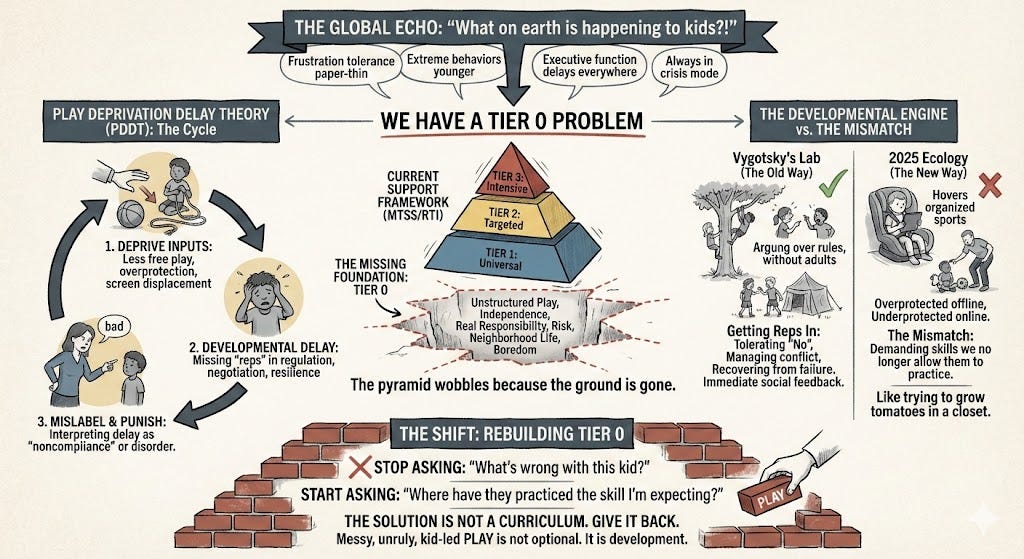
Because once you really see it, the question changes. It is no longer just whether Tier 0 “matters,” and it is no longer just whether we can squeeze in a few more minutes of recess without the system pushing back. The question becomes whether childhood itself is being treated like something that deserves a standard of care.
If you want the one-sentence version of what I am arguing, it is this: institutions that serve children should have to prove they are environments fit for healthy human development. Full stop.
Just as public buildings must meet fire codes and hospitals must meet sanitation standards, I predict schools will one day be expected to meet a developmental standard of care and prove they are an environment fit for human development.
The minimum conditions required for healthy human growth are well-researched:
Some freedom to move
Frequent chances to communicate with peers
Some autonomy
Secure belonging
Self-directed play and peer life
Real-world competence building
Repair and restoration instead of punishment
When these conditions are present, development accelerates. When absent, development delays, often showing up as behavior, disengagement, anxiety, or fragility. This is not speculation. Research shows that less-structured time predicts stronger self-directed executive functioning, unstructured play predicts later self-regulation, and nature exposure supports attention and cognitive restoration.
What we call “behavior problems” are often developmental signals from an unhealthy modern school system that is misaligned with human growth.
That idea started crystallizing for me, as these things usually do, through something small that refused to stay small.
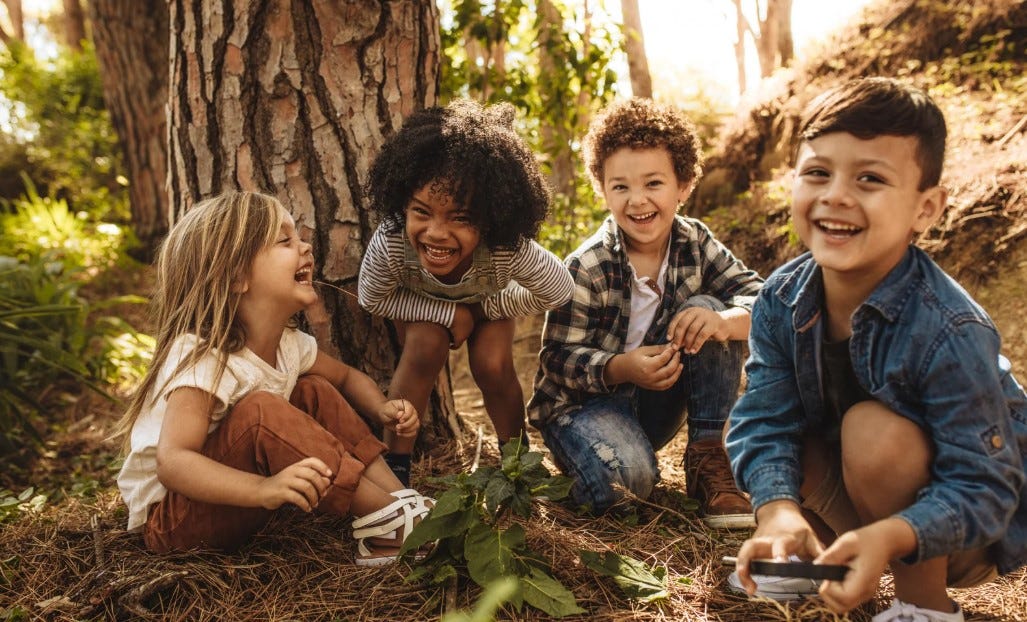
A few weeks ago, our standardized math curriculum required plastic cubes. Arrays. Rows and columns. Repeated addition. A tidy artifact for the system. Instead, I took my third graders outside to the forest and told them to build arrays out of whatever they found interesting - pinecones, sticks, rocks, acorns, whatever.
The learning did not weaken. It deepened. Immensely.
Not because the woods are magical, and not because kids cannot learn indoors. The math deepened because everything underneath the math came alive. They were in a full-sensory environment rich with meaning, wildness, and depth - not sterilized plastic and florescent lights. Kids negotiated structure, reasoned, and argued when they realized living materials are often unevenly sized. One learned to adapt when her original plan to find 18 acorns fell apart and she could only find 11. They persisted longer. They asked questions about nature that were not on the lesson plan, and those questions were not distractions. They were the engine. They were not rotating through “math,” “science” and “social emotional learning” like little office workers.
They were learning as whole human beings.
And it reminded me again that school is built on a model of childhood development that does not exist in reality.
School divides learning into compartments. We do it so automatically that it feels like reality, the same way a fish never questions the water it’s swimming in. Now it is math time. Now it is reading. Now it is science. Now it is social emotional learning. Now it is art class. Now sit still. Now focus. Now prove you learned the lesson via multiple choice questions.
Modern school systems would be excellent if they were designed for businesses, but they are not at all how humans grow.
Human development is integrated. Thinking, feeling, moving, relating, communicating, noticing, and meaning-making develop together through lived experience. Cognitive science has argued for decades that cognition is grounded in perception and action, not separated into tidy mental boxes where the “thinking part” runs independently of the body and the world.
So when kids struggle, the first question should not be “What is wrong with this child?” An honest starting question should be, “What kind of childhood did we build, and what kind of human did we expect it to produce?”
The point is not to romanticize childhood or demonize schools. The point is to admit that we keep asking children to do something that looks like “success” on paper while ignoring the conditions that make true success impossible in a living human body.

The Soil and the Fertilizer
A second parable helps me name the same pattern in a different way.
Imagine a farmer whose plants keep wilting. The farmer adds fertilizer, switches brands, increases doses, measures more closely, reads the latest research on fertilizers, installs a more sophisticated fertilizer delivery system. The plants perk up for a moment and then wilt again.
At some point, a different question has to rise to the surface, a question that feels almost offensive because it suggests the farmer’s whole strategy was misguided.
What if the problem is not the fertilizer? What if the soil is depleted? That is Tier 0 in a sentence. We keep arguing about fertilizers: which program, which curriculum, which intervention, which behavior system, which tool, which initiative. All while the developmental soil is depleted.
No matter how expensive the fertilizer, and how much “rigor” was involved in it’s distribution, plants do not flourish in dead soil. No matter how vetted the curriculum, learning does not flourish without a rich developmental foundation.

Environments Fit for Human Development
Here is the shift I want to put into the center of the conversation.
Institutions that serve children should be expected to meet a developmental standard of care, the way hospitals are expected to meet standards of sanitation and buildings are expected to meet safety codes. They must be, first and foremost, environments fit for human development.
Decades from now, I think the question will not only be, “Is this a good school?” It will be, “Is this a developmentally healthy environment for a human child?” That question matters because it changes where responsibility sits. It stops letting systems outsource the problem to children. It stops having a deficit mindset that blames the child…or the parents…or the teacher. Environments fit for human development do not require perfection, and they do not require chaos disguised as child-centeredness. They require alignment. They require that environments provide the minimum conditions human beings need in order to mature into healthy, collaborative, capable, socially fluent people.
At minimum, those conditions include autonomy, belonging, competence, movement, meaningful challenge, communication with peers, real-world experience, and a culture of repair instead of humiliation or punitive action. Motivation science has been remarkably consistent that autonomy, competence, and relatedness are basic psychological needs, and that supporting them strengthens motivation and well-being while chronic thwarting erodes both.
This is where the debate usually turns into something smaller than it should be, because people hear “autonomy” and think “no structure.” The actual point is that structure can either support development or suppress it, and many of our structures increasingly do the latter. Studies on children’s time use found that more time spent in less-structured activities predicted stronger executive functioning, while more time in structured activities predicted the opposite pattern.
If you have ever wondered why children seem less able to direct themselves than they used to, it is hard to ignore the possibility that we have been systematically removing the very kind of time where children practice directing themselves. Then we blame them for not having practiced.
Even the “outside” piece fits here in a surprisingly practical way. Attention is finite. Directed attention gets fatigued. A systematic review describes evidence that exposure to natural environments can help restore attention. When kids come back from outside calmer and more focused, it’s not a quirky “brain break.” It is biology being given the conditions it needs.
The Hidden System
At this point someone usually wants to argue about teachers, as if the box model exists because teachers lack imagination. Teachers did not design the box model. Teachers live inside it. The box model persists because it makes systems legible, schedulable, and measurable. It makes comparison possible. It makes accountability pipelines happy. It makes the adult world feel in control.
The problem is what happens when measurement becomes the main legitimacy test. Childhood gets reorganized around what is easiest to graph rather than what is most important to grow.
Movement becomes expendable. Play becomes optional. Curiosity becomes “off-task.” Belonging becomes a slogan. The child becomes a data point. Then we act surprised when the humans inside the system behave like humans under strain.
What This Means Tomorrow Morning
If this stays philosophical, it does not help anyone. So here are the two simplest practical questions I know:
Are we designing for measurement, or are we designing for development?
and
Do we want our scores to look great, or do we want kids to actually be great?
Then pick one upstream condition you can strengthen without turning it into another compliance program.
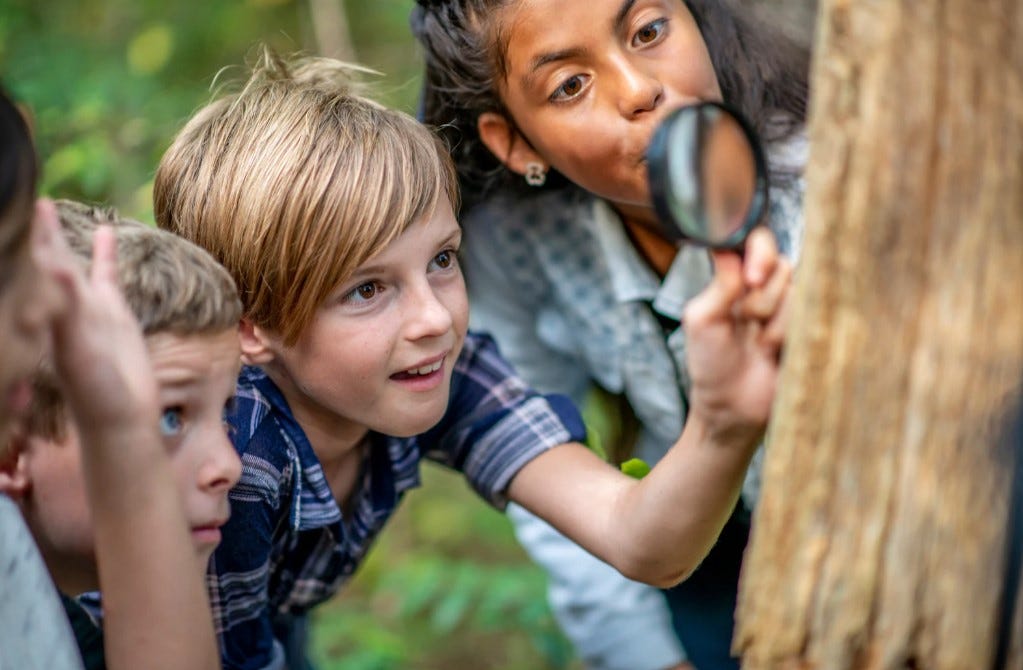
You can protect a daily block of genuine self-direction. You can make movement and outdoor time non-negotiable rather than earned. You can redesign lessons where subjects stop pretending to be separate and start behaving like real life - the way that forest array lesson did. You can build repair into the culture so relationships strengthen instead of fraying. You can grow progressive agency across the year by transferring responsibility as readiness grows.
Then you can do the improvement-science thing: change one condition, watch what changes downstream.
Because when conditions shift, outcomes shift.
A Call to Educators
If you are a teacher reading this, you are not crazy for feeling like you are doing triage all day. You are not failing because your classroom sometimes feels like a behavior-management clinic with academics squeezed into the gaps. You are living downstream from forces you did not create.
But you can still go upstream in your own way. You can protect one condition of growth and refuse to apologize for it. You can stop building bigger docks inside your classroom and start strengthening the soil.
If you’re an administrator, you may not be able to undo the societal forces that eliminated Tier 0 -but you can choose not to be complicit in them. You can protect recess. You can protect movement. You can stop treating time outside as a reward instead of a right. You can stop creating schedules that expect children to sit still and self-regulate for hours like adults, even as they are still becoming. You can reject silent cafeterias, hushed classrooms, and micromanaged playgrounds. You can stop allowing your teachers to take recess away.
Just this past month, I heard from two teachers in two different states. Both told me their principals had banned running…on the playground. That’s the kind of control that needs to stop. Stop equating strict control and rigid micromanagement with success. In the long run, it produces success in the wrong things.
Humans, plants, animals (all living things) need space to move, freedom to grow, and environments that nurture, not restrict, what their very biology demands. For kids that mean talking to peers, making low-stakes decisions, frequent movement, protected free play, and some autonomy.
Can We Afford Not to Rebuild?
I do not believe we are living through a generation of broken children. I believe we are watching human development strain inside environments that have drifted further and further from what growing humans actually need. Slowly, almost invisibly, we learned to normalize it. We built bigger docks while more casualties kept floating downstream. We kept adding more fertilizer while the soil beneath us died.
At some point, going upstream stops being a hopeful idea and becomes a moral responsibility.
A healthy society does not treat childhood like a production line. It treats childhood like the living infrastructure of its future. The question is no longer whether we can afford to rebuild the foundation. The question is whether we can afford not to.
Children do not become fully human through pressure. They become human through lived experience inside environments fit for human development.
And cultivating environments fit for human development is what it looks like when we finally stop pretending the upstream work is optional.
This is fantastic! I am moved by the question shift from what is wrong with this child to what were the conditions of their childhood that we created and what did we expect. Incredibly powerful.
I saved this because I don’t have time to read it fully at the moment, coming here after digesting Adrian Neibauer’s lovely reflection on restorative classroom practices, but from a first glance, I think about this stuff all the time.
My newsletter The Bending is about the school-to-prison pipeline - learning about the juvenile justice system as an educator and sharing my learning with others. My main focus is keeping kids out of that system.